

An IP nurse call system is the most advanced class of nurse-patient communication technology available today. Unlike wired systems that rely on dedicated copper cabling, or wireless systems that use radio frequencies, an IP-based nurse call system operates over standard Ethernet networks (TCP/IP) — the same infrastructure that powers a hospital’s computers, phones, and security systems.
This means the nurse call platform becomes part of the hospital’s IT ecosystem rather than a standalone appliance. The result: real-time patient data at every bedside, deep integration with hospital information systems (HIS/EMR), and a communication backbone that scales with the facility.
What Makes IP Nurse Call Different?
The fundamental shift is architectural. A wired or wireless system is a closed loop: bedside button → dedicated wire or RF signal → nursing station. An IP system is an open network: every bedside terminal, corridor display, and nursing station console is a network node with its own IP address, communicating over standard protocols.
This architectural difference unlocks capabilities that closed-loop systems cannot deliver:
| Capability | Wired / Wireless | IP-Based |
|---|---|---|
| Network type | Dedicated closed circuit | Standard Ethernet (TCP/IP) |
| Patient data at bedside | Room number only | Full patient demographics, care plan, allergy alerts, physician name |
| HIS/EMR integration | None | HL7 / API-based, real-time sync |
| Voice/video intercom | Analog audio (wired) or none | HD VoIP, optional video |
| Mobile nurse alerts | Pagers or proprietary receivers | Smartphone app, SIP phone, web dashboard |
| Remote administration | On-site only | Web-based management from anywhere |
| Scalability | Limited by cabling or frequency | Virtually unlimited — add nodes to the network |
| Data analytics | None | Call logs, response time metrics, staffing analytics |
Core Components of an IP Nurse Call System
1. IP Bedside Terminal
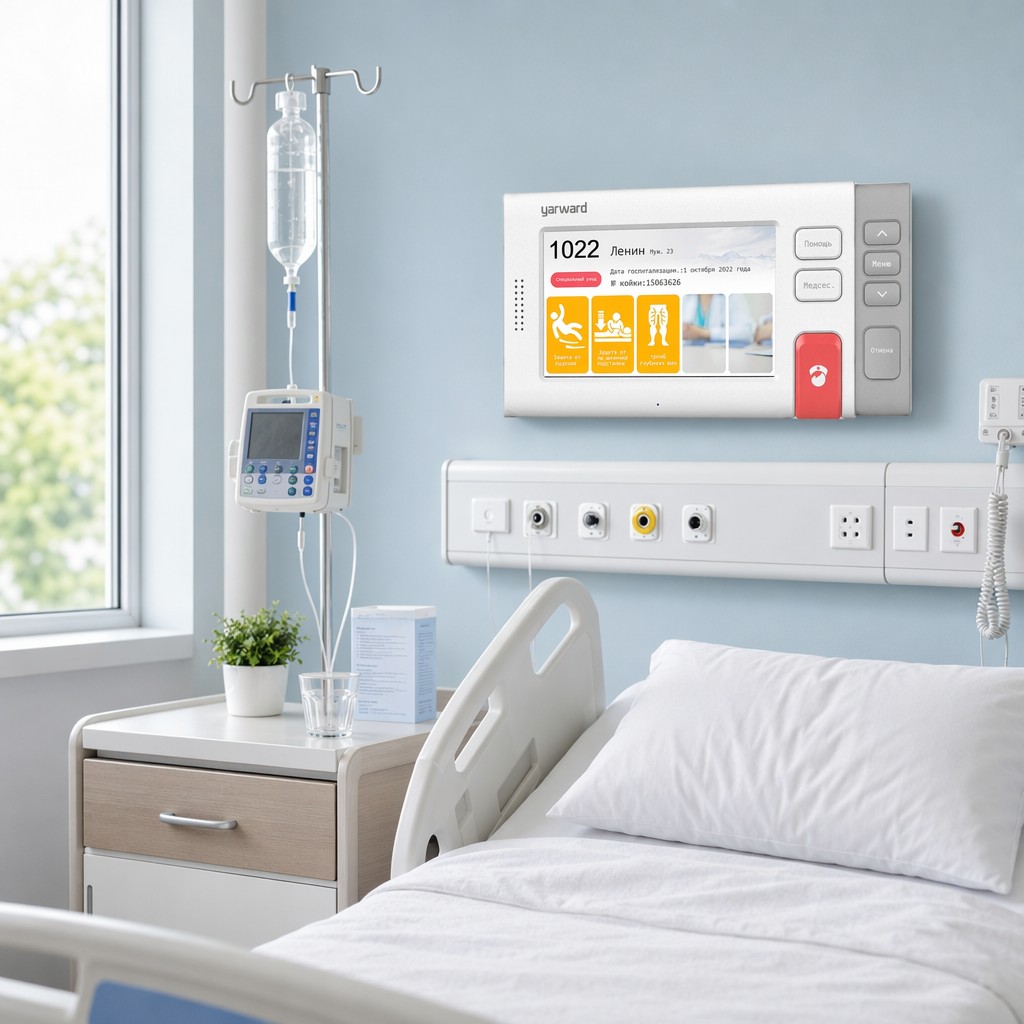
The bedside terminal is the patient’s interface. In an IP system, it is a full-featured touchscreen device — not just a call button. It displays the patient’s name, attending physician, care instructions, allergy warnings, and fall-risk or DVT-prevention alerts pulled from the hospital’s EMR in real time. Patients initiate calls, speak with nurses via VoIP, and access entertainment or educational content — all from a single bedside panel.
2. IP Nursing Station Console
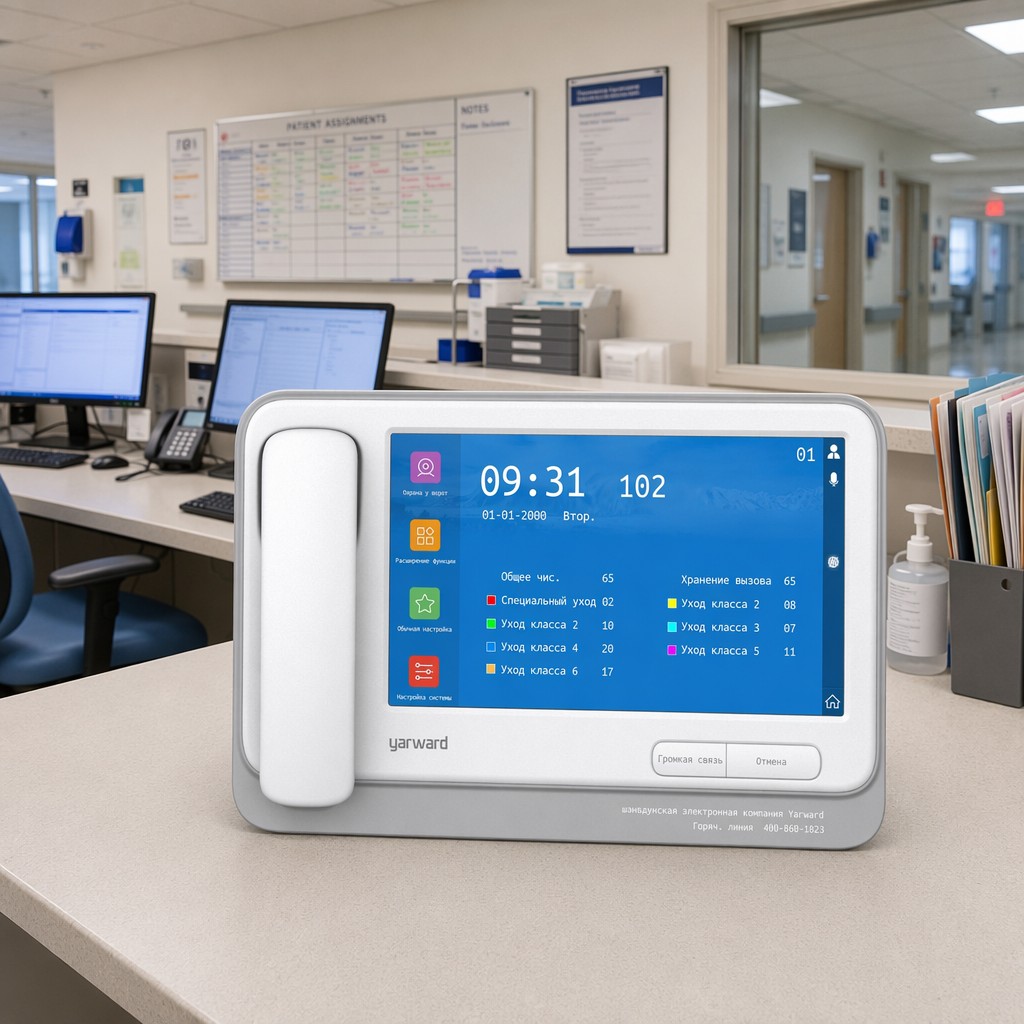
The nursing station console aggregates all ward activity: incoming calls by priority, patient status overview, staff assignments, and escalation workflows. Nurses can answer calls with two-way voice, view the calling patient’s record, and triage requests without walking to the room — reducing unnecessary trips and improving response time for genuinely urgent calls.
3. Communication Host (Backend Server)
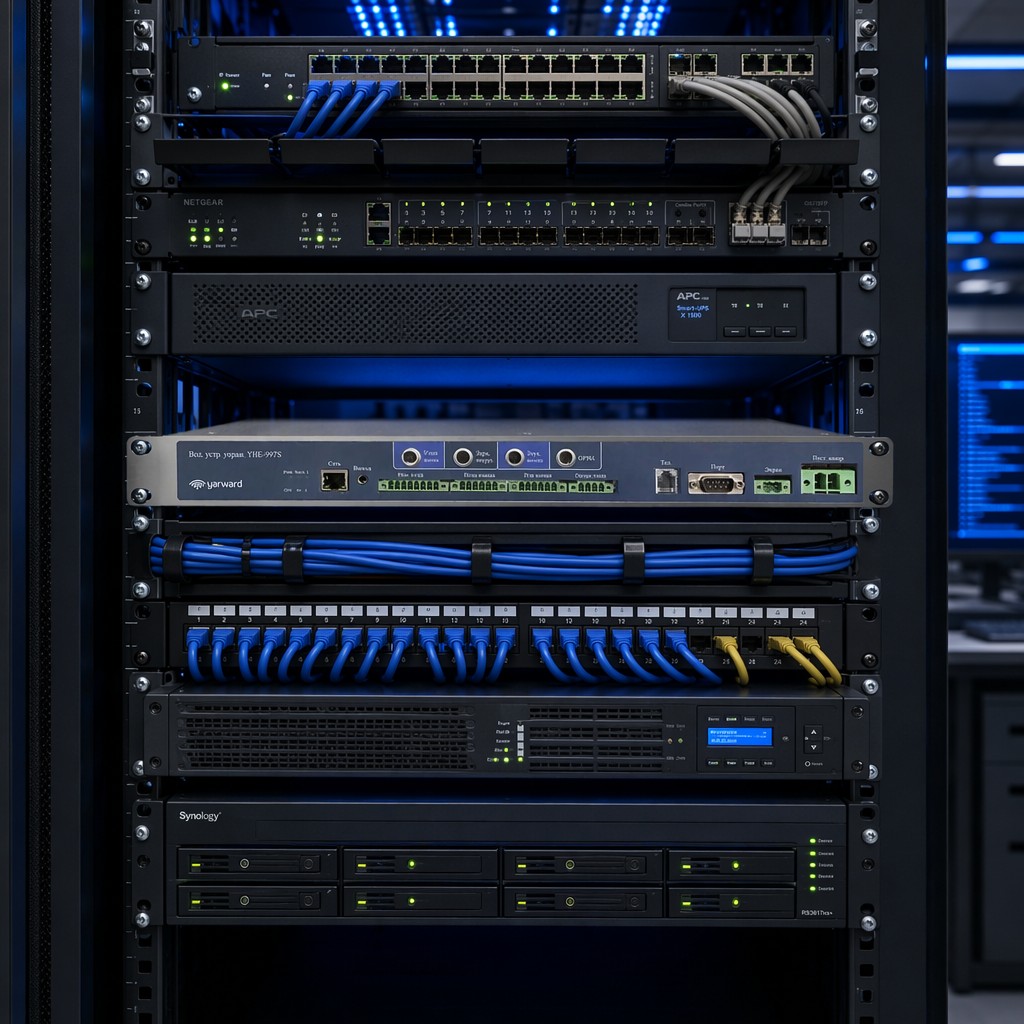
The communication host is the central server that routes all signals, maintains the call database, and bridges the nurse call network with the hospital’s broader IT infrastructure. It runs 24/7 in the hospital server room, with redundant power and failover protection. This is where HIS integration happens — the host queries patient demographics, admission/discharge/transfer (ADT) data, and care orders, then pushes that information to the appropriate bedside terminals in real time.
4. Corridor Displays & Information Dashboards
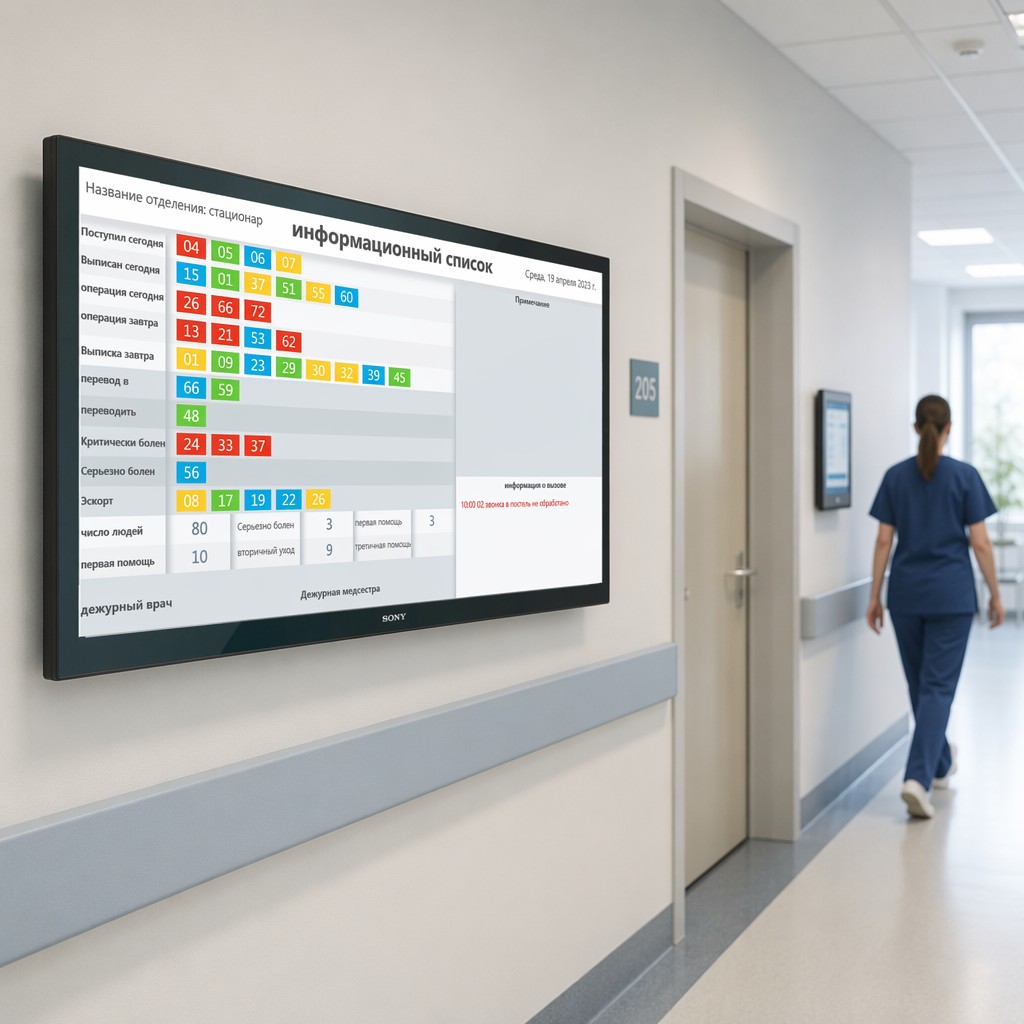
IP corridor displays go beyond simple “Room 302 Calling” indicators. They function as ward-level information dashboards: showing bed occupancy, today’s admissions and discharges, upcoming surgeries, critical patient alerts, and staff assignments. In an emergency, the display can broadcast code-blue alerts or evacuation instructions across the entire wing simultaneously.
Benefits That Impact the Bottom Line
Faster Nurse Response, Fewer Steps
When a patient presses the call button, the IP system routes the alert directly to the assigned nurse’s smartphone or the nursing station console — with patient context attached. The nurse sees who is calling, why (if the patient selected a reason), and relevant care alerts before answering. This eliminates the “walk to the room to find out what they need, then walk back to get supplies” loop that wastes an estimated 60-90 minutes per nurse per shift.
Medication Error Reduction
When allergy warnings, fall risks, and DVT precautions are displayed directly on the bedside terminal — pulled from the EMR, not manually entered — the risk of a nurse missing a critical patient flag drops dramatically. The system acts as a second set of eyes at the point of care.
Data-Driven Staffing Decisions
Every call is logged: time, location, response time, resolution time. Over weeks and months, this data reveals patterns — which shifts are understaffed, which wards have unusually high call volumes at specific times, which nurses consistently outperform on response time. Nursing managers use these analytics to optimize schedules and justify staffing requests with hard data, not anecdotes.
Accreditation-Ready Audit Trails
Joint Commission (JCAHO) and other accreditation bodies increasingly expect auditable records of patient-staff communication. An IP nurse call system automatically maintains a time-stamped log of every call, every response, and every escalation — ready for review during an inspection.
Is an IP Nurse Call System Right for Your Facility?
IP is the most capable option — but it requires existing Ethernet infrastructure or a willingness to install it. Use this decision guide:
| Your Facility | Recommendation |
|---|---|
| New hospital construction or major renovation | IP — plan Ethernet drops to every bed. The incremental cost over wired is small, and the capability gap is enormous. |
| Existing hospital with campus LAN | IP — leverage the network you already have. Most modern hospitals already run Ethernet to nursing stations; extending to patient beds is a manageable project. |
| Smart hospital / digital transformation initiative | IP is mandatory. You need HIS integration, data analytics, and mobile workflows — none of which wired or wireless can deliver. |
| Small nursing home, no IT staff | Wireless is more practical. IP requires network management capability. |
| Temporary field facility | Wireless — fast deployment, no infrastructure. |
Why Yarward IP Nurse Call Systems?
Yarward designs and manufactures the full IP nurse call stack — bedside terminals, nursing station consoles, communication hosts, and corridor displays — in-house. This means:
- Single-vendor integration. Every component is designed to work together from the start. No compatibility issues between different manufacturers’ hardware.
- Customization at the factory level. Need a specific workflow, a different language on the UI, or integration with an unusual HIS? Yarward’s R&D team modifies the software and firmware in-house.
- Proven at scale. 300,000+ beds equipped, 2,000+ hospital installations, CE and FCC certified.
- End-to-end support. From network planning and site survey to installation, training, and ongoing remote diagnostics — Yarward supports the full lifecycle.
Browse IP nurse call systems → or contact our engineering team for a technical consultation.
Frequently Asked Questions
Does an IP nurse call system work if the hospital network goes down?
Yes. Yarward IP nurse call systems include local failover — bedside terminals and nursing station consoles continue to operate for basic call-and-response even if the main network is interrupted. HIS integration and remote features require network connectivity, but the core call function remains active. The communication host also supports redundant power supplies and RAID storage.
How long does IP nurse call installation take?
If Ethernet cabling is already in place to patient beds, installation takes 3-7 days for a typical 100-bed ward — similar to wireless. If new cabling is required, add 1-2 weeks for structured cabling work. Yarward provides a pre-installation site survey and network readiness assessment as part of every project.
Can we phase the rollout — start with one ward and expand?
Yes. This is the most common deployment model. Start with one ward or floor, validate the workflow, then expand. Because IP systems are modular and network-based, adding new wards is a matter of connecting additional bedside terminals and configuring them on the communication host — no system-level hardware replacement needed.
What HIS/EMR systems does Yarward integrate with?
Yarward IP nurse call systems support HL7 v2 and FHIR standards, which cover the vast majority of hospital information systems worldwide — including Epic, Cerner, Meditech, and regional platforms. Custom API integrations are also available through Yarward’s R&D team for non-standard systems.
Post time: 07-18-2026