

A wireless nurse call system replaces physical cabling with radio frequency (RF) or Wi-Fi signals to connect patients with nursing staff. For healthcare facilities looking to upgrade without tearing open walls — or to add flexibility to an existing care environment — wireless is often the fastest, most cost-effective path forward.
In this guide, we break down how wireless nurse call technology works, where it performs best, what to consider before purchasing, and how it compares to wired and IP-based alternatives.
How a Wireless Nurse Call System Works
At its core, a wireless nurse call system has three components:
- Call trigger — a bedside button, handheld pendant, or pull-cord that the patient activates
- Signal transmission — the call travels via RF or Wi-Fi to a central receiver or directly to staff devices
- Alert delivery — the signal reaches a nursing station display, corridor light, mobile handset, or pager
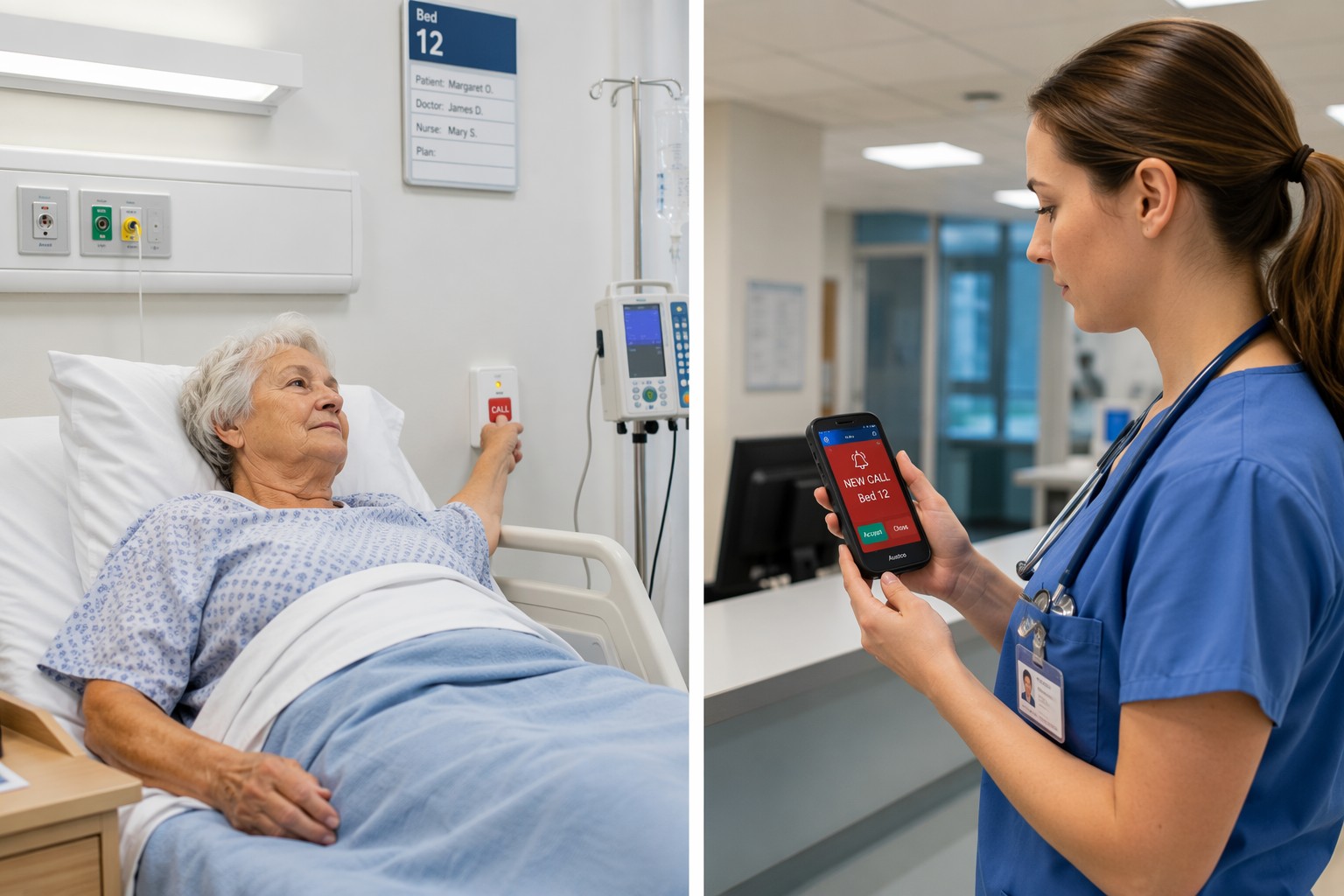
Unlike wired systems where signals travel through physical copper, wireless systems modulate data onto radio frequencies. Yarward wireless nurse call systems use proprietary frequency-hopping spread spectrum (FHSS) technology to avoid interference from other hospital equipment — a critical consideration in environments crowded with Wi-Fi, Bluetooth, and medical telemetry devices.
Key Advantages of Wireless Nurse Call
| Advantage | Why It Matters |
|---|---|
| No structural cabling | Installation can happen over a weekend without construction disruption — critical for operating facilities that cannot shut down wards |
| Flexible deployment | Call points can be moved, added, or reconfigured as ward layouts change. Nursing homes can add units as resident count grows |
| Lower upfront cost | No cable pulling, conduit work, or drywall repair — wireless installation is typically 40-60% cheaper than wired for existing buildings |
| Mobile caregiver alerts | Calls route directly to nurses’ handheld devices or wrist receivers, cutting response time by eliminating the “run to the nursing station to read the display” step |
| Rapid retrofitting | Heritage hospital buildings, temporary field hospitals, and converted care spaces can be equipped in days |
Where Wireless Nurse Call Performs Best
Nursing Homes & Assisted Living
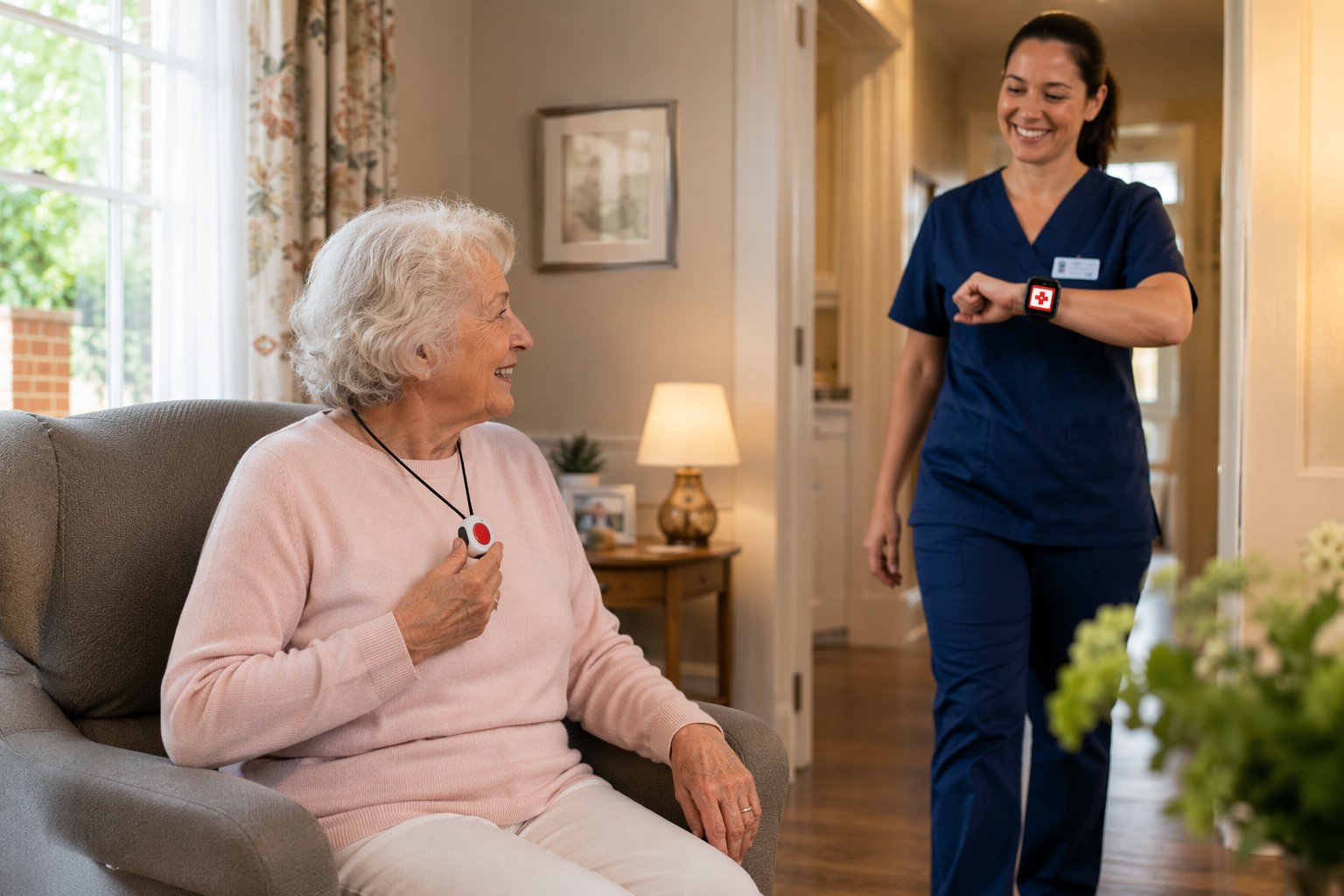
Wireless nurse call is the dominant choice for long-term care. Residents have varying mobility levels — some are bed-bound, others walk freely around the facility. A wireless system with wearable pendants and fixed bedside units covers both scenarios without the cost of wiring every room.
Hospital Ward Retrofits
When a hospital needs to upgrade an existing ward — built 20 years ago without structured cabling for modern nurse call — pulling wire through concrete walls is expensive and disruptive. A wireless nurse call system provides the same functionality with near-zero structural impact. The ward remains operational during installation.
Temporary and Field Facilities
Field hospitals, pop-up clinics, and disaster-response units need communication infrastructure that sets up in hours, not weeks. Wireless nurse call systems are inherently portable — pack up, move, and redeploy at a new site with minimal reconfiguration.
Wireless vs. Wired vs. IP Nurse Call: Which Should You Choose?
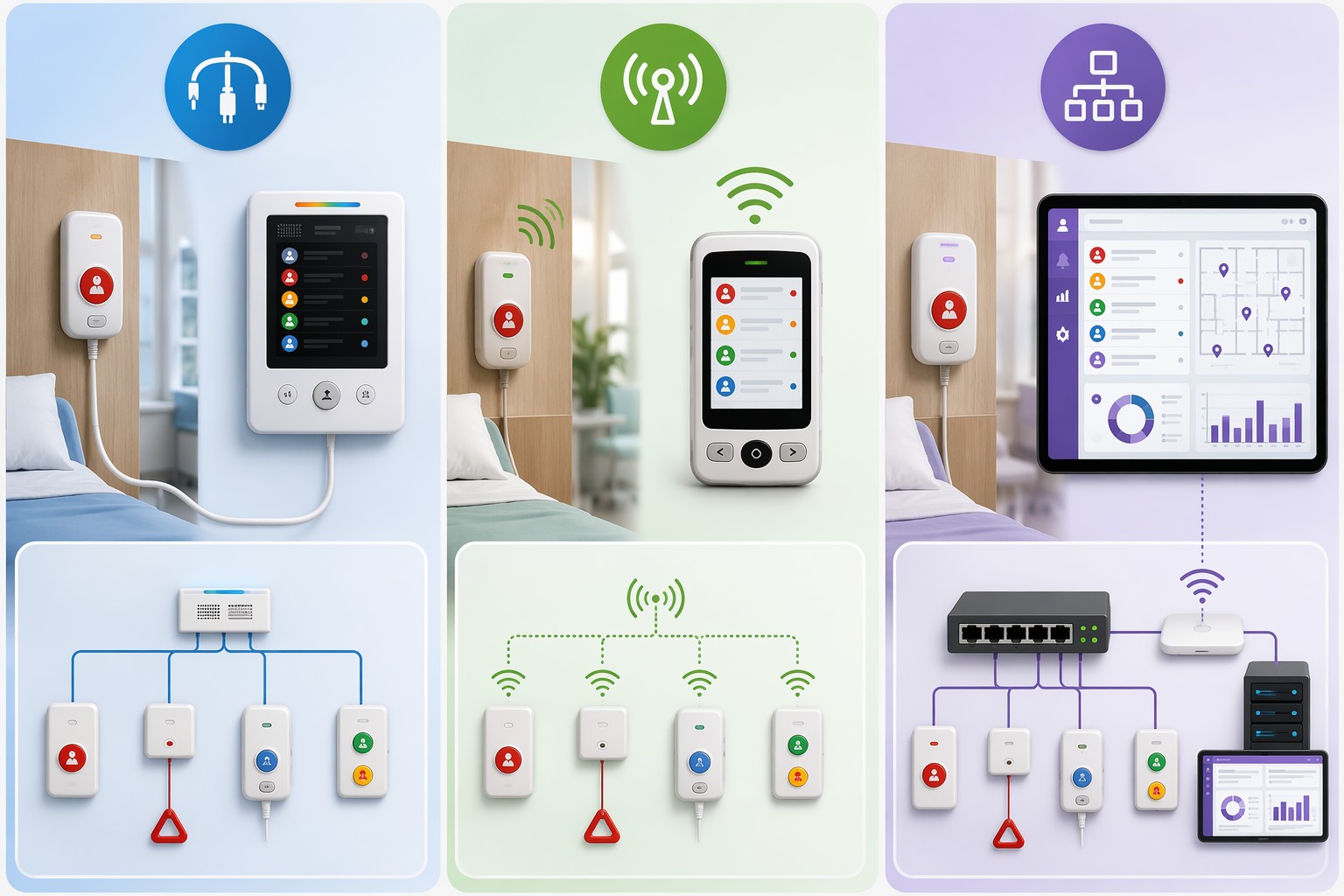
| Feature | Wired | Wireless | IP-Based |
|---|---|---|---|
| Installation speed | 2-4 weeks | 1-3 days | 3-7 days (with existing network) |
| Signal reliability | Highest (physical connection) | High (FHSS/encrypted) | Highest (TCP/IP) |
| Scalability | Requires additional cabling | Add units freely | Virtually unlimited |
| HIS/EMR integration | Limited or none | Limited or none | Full HL7/API integration |
| Best for | New construction | Retrofits, nursing homes, temporary facilities | Large hospitals, smart hospital initiatives |
Rule of thumb: If you are building new and can plan cabling → wired. If you need fast, flexible deployment in an existing building → wireless. If you need HIS integration and deep data → IP.
5 Questions to Ask Before Choosing a Wireless Nurse Call System
- What is the building construction? Thick concrete walls and metal framing attenuate radio signals. A site survey should precede any wireless purchase.
- How many beds now, and in 5 years? Choose a system that scales without replacing the central controller. Yarward wireless systems support modular expansion.
- What other wireless equipment is in use? Co-existing with hospital Wi-Fi, telemetry, and Bluetooth requires frequency planning. FHSS-based systems handle this better than fixed-frequency alternatives.
- What devices do nurses already carry? If your staff already uses smartphones, a system that sends alerts to an app eliminates the need for additional pagers or receivers.
- What is the total cost of ownership? Wireless has lower upfront cost, but factor in battery replacement for portable call points and periodic signal health checks.
Why Yarward Wireless Nurse Call Systems?
Yarward Electronics has been engineering nurse call solutions since 1998. Our wireless nurse call systems are deployed in hospitals and nursing homes across 30+ countries, with features designed for real-world clinical environments:
- Frequency-hopping technology — avoids interference from competing wireless devices in dense hospital environments
- Two-way voice intercom — nurses can speak directly with patients before walking to the room, triaging calls more efficiently
- Modular design — start with 20 beds and expand to 200 without replacing the central controller
- Multi-receiver routing — calls can simultaneously alert the nursing station display, corridor light, and assigned nurse’s mobile device
- Battery management — low-battery alerts on portable call points prevent unexpected downtime
Browse wireless nurse call systems → or contact our team for a consultation tailored to your facility.
Frequently Asked Questions
Will a wireless nurse call system interfere with hospital Wi-Fi?
Modern FHSS-based wireless nurse call systems operate in dedicated frequency bands and use spread-spectrum technology to avoid interference. Yarward systems are tested for co-existence with standard hospital Wi-Fi (2.4 GHz and 5 GHz), Bluetooth, and medical telemetry equipment. A pre-installation site survey is included with every deployment.
How long do wireless call button batteries last?
Bedside call buttons typically last 12-18 months on a single battery under normal use. Wearable pendants and pull-cord triggers last 8-12 months. All Yarward wireless units include low-battery monitoring and alert the nursing station when replacement is needed.
Is a wireless nurse call system reliable enough for critical care?
For general wards, nursing homes, and assisted living — yes. For ICU and critical care environments where absolute signal reliability is non-negotiable, we recommend an IP-based system with wired failover. Yarward offers hybrid configurations: wireless for general wards, IP for intensive care, managed from a single platform.
Post time: 07-18-2026